
Research and Development
Clinical Research in Australia
In partnership with doctors in Australia we focus our skills and resources on getting life-changing medicines to patients as quickly, safely and efficiently as possible. We are currently conducting research to develop new medicines in the following disease areas:

Oncology

Cardiovasuclar, Renal and Metabolism

Respiratory and Immunology

Rare Disease
The clinical research we conduct spans across all the phases that a new medicine has to go through before it can be made available.
We also support academic investigators in their own research endeavours and collaborate and advocate with government to make sure that research policy helps bring further research into Australia.
Key links & contact details
- Should you be interested to learn more about the studies AstraZeneca is currently conducting, please visit the AstraZeneca Clinical Trials website.
- To find out more about clinical trials in Australia, please visit the dedicated Australian Government website https://www.australianclinicaltrials.gov.au/
- If you are interested in participating in a trial as a patient please contact us on our Medical Information Line on 1800 805 342.
- If you're interested in participating in a trial as an investigator please contact us via AustralianClinicalResearch@astrazeneca.com
Externally Sponsored Research
Externally Sponsored Research (ESR) is research that is initiated and managed by an external researcher who assumes the legal and regulatory responsibility for the conduct and management of the research as defined by applicable regulations and laws of the country involved.
AstraZeneca currently support the following types of externally sponsored scientific research proposals:
- Interventional Clinical Research (Phase I - IV) - involving authorised, unauthorised or discontinued AstraZeneca compounds no longer being developed.
- Observational Research (i.e., Real World Evidence - RWE) - the product of interventional or non-interventional research, utilising data collected through observation of current clinical practice and/or patient reported experience.
- Non-Clinical Research (pre-clinical research) - involving compounds across all Disease Areas and phases of development. This includes in vitro, in vivo or ex vivo biomedical research across pharmacodynamics, pharmacokinetics, animal studies, microbiologic and human biological samples (biomarkers, diagnostic assays). Requests for non-clinical research can be made via the AstraZeneca Open Innovation portal.
Ready to submit a research proposal?
Login and complete the ESR submission form on our submission tool - Veeva Clinical Vault (VCV) for Externally Sponsored Research (ESR) or VCV for ESR, supports the submission, management and operations of requests from registered external partners. Once the training and registration process are completed, external partners have the opportunity to raise and submit externally sponsored research proposals. Please note, submissions may require the following:
- A current CV - updated within the last two years
- Funding budget plan, if financial support requested
- Additional supporting documentation, if required
For more information about the submission process and how to use the system please see the Externally Sponsored scientific research partner Training Centre.
Click here to go to the AstraZeneca Externally Sponsored Scientific Research page
Animals in Research
How and why and how we use animals in research and teaching.
We acknowledge, both internally and externally, that we carry out and fund the use of animals in research and teaching and that we seek to be open about the use of animals in research.
The use of animals in research is a small but vital part of the process of bringing new medicines to patients. Although advances continue to be made in non-animal alternatives, some animal studies remain necessary to explore and understand fundamental science, as well as to establish the safety and efficacy of new medicines before they reach patients.
In 2022, animals were used for in-house studies approximately 100,803 times (2021: 93,511). Animals were also used on our behalf for contract research organisation studies approximately 55,455 times (2021: 58,826). In total, over 98% were rodents or fish.
Our approach to Animals in Research
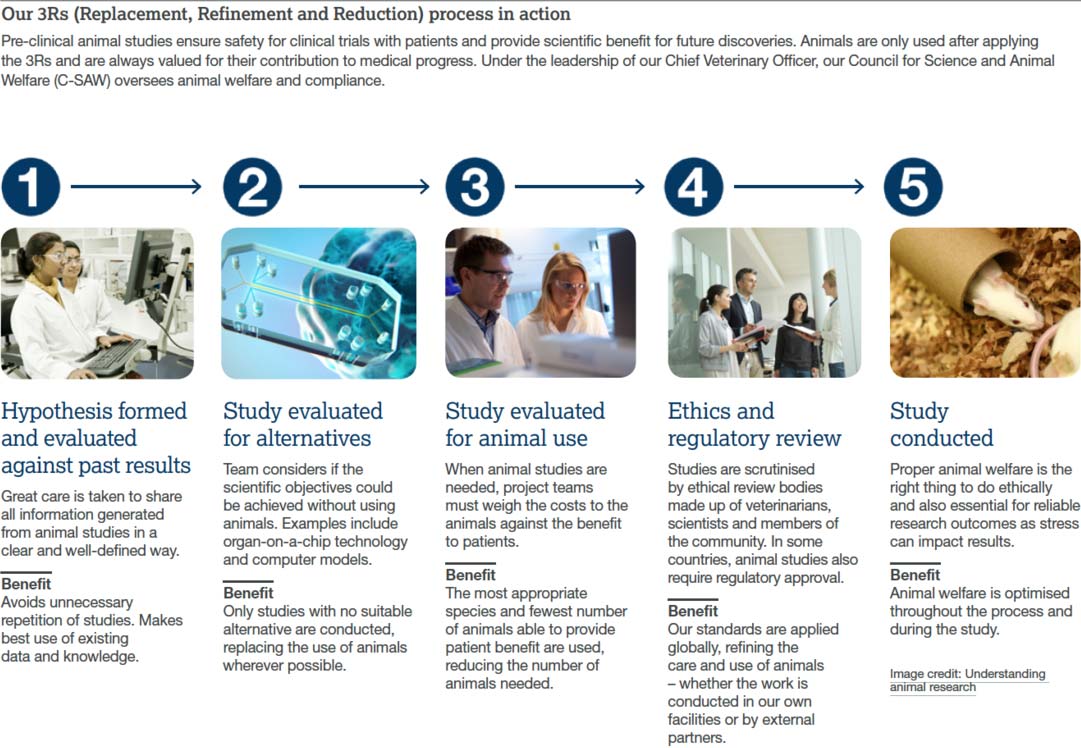
We consider the responsible use of animals to be ethically appropriate in biomedical research and product development, where suitable non-animal alternatives are not available. We share the concerns for animal welfare and recognise this as a serious responsibility. We are actively committed to high standards in animal care and to the principles of the ‘3Rs’ – Replacement, Reduction and Refinement of animals in research – as well as being open and transparent about our work with animals. The Council for Science and Animal Welfare (C-SAW) is the expert group leading our global approach to animals in research, promoting the application of the 3Rs, supporting openness about animal use, and providing assurance that we meet our standards. We apply consistent standards to all work involving animals, whether it is conducted ourselves or by third parties acting on our behalf.
We have been a signatory to the Openness Agreement on Animal Research and Teaching in New Zealand since July 2021 and the Concordat on Openness on Animal Research in the UK since 2014. We encourage our scientists and animal care teams worldwide to explore opportunities for increasing openness about the use of animals in science.
Promoting Animal Welfare and A Culture of Care
We recognise and celebrate our scientists and animal care staff, globally, for exceptional commitment to the 3Rs— replacement, reduction and refinement of animals in research. Our C-SAW Global 3Rs Awards is a competitive and highly visible awards program that recognises excellence in 3Rs science and encourages continuing improvements in animal welfare across our company and with our external partners. Alongside the 3Rs Awards, we also call for nominations for exceptional individuals and teams in the categories of “Culture of Care” and “Openness” about animal research.